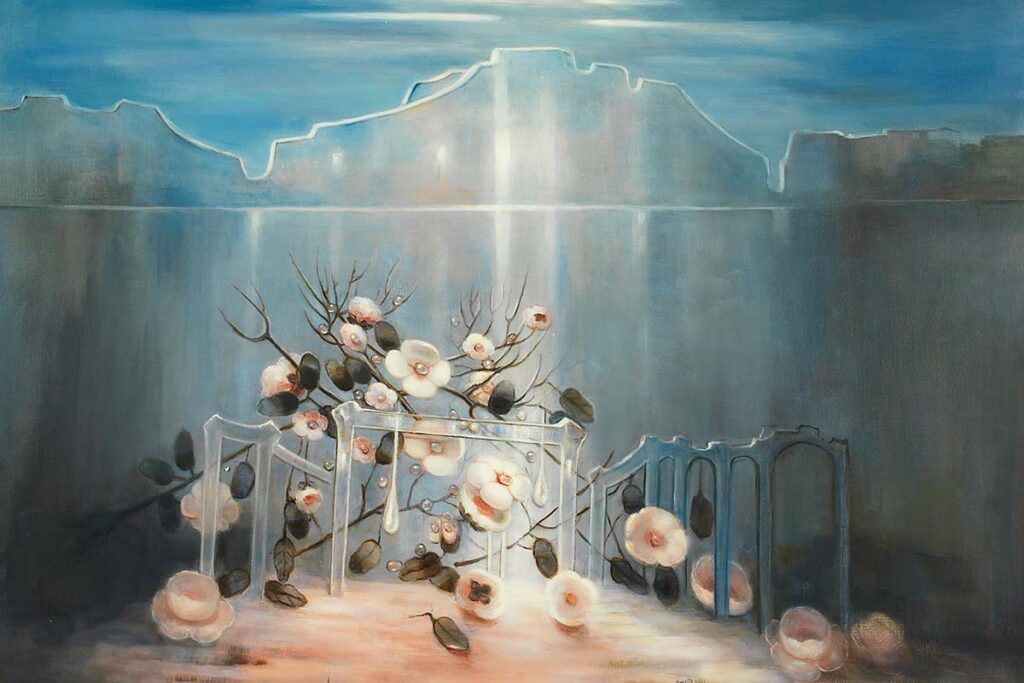
Imagine you are seated inside a spacecraft that has been drifting aimlessly through space for years. Then one day, without warning, a radiant shimmer of multicoloured light streams through the window and settles gently upon your face. Startled, you rush toward the window and gaze outside in awe—only to realize that you have entered an entirely new world.
A world of exploding light, of glass, ice, and pearl.
A world of silence and profound horizons.
A crystalline world where flowers are human, and humans are absent.
This is my experience of gazing at the paintings of Iran Darroudi.
Some artists paint what they see; others paint what they feel. Darroudi, in my view, first sees what she feels—and only then paints it. Perhaps this is because the distance between the artist and the art is so small… sometimes nonexistent.
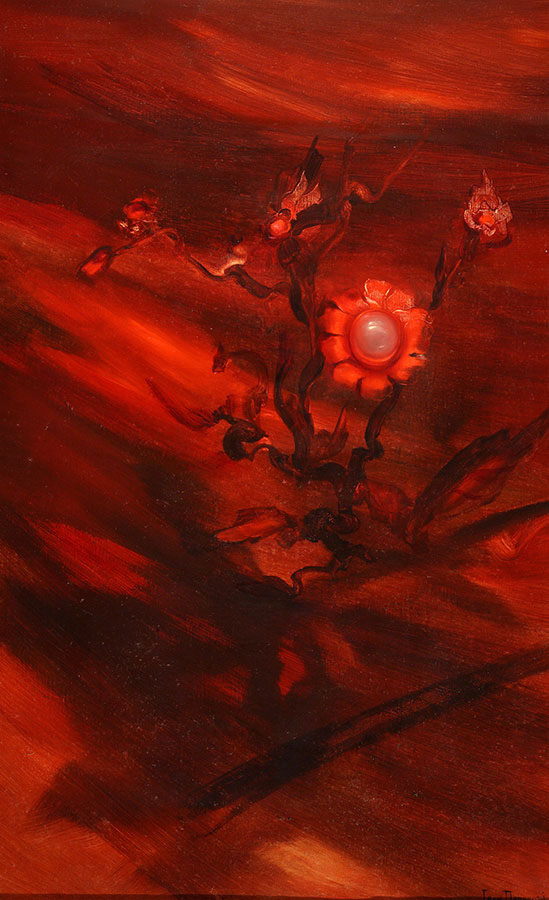
Even if you strip away certain imposed elements—like overt displays of patriotism, hints of Eastern mysticism, or the poetic titles—you are still left with an entire universe of pure feeling.
Yet, she herself seems to mistakenly attribute her recognition to external influences. For instance, the poem Ahmad Shamlou wrote as the introduction to her first collection—aside from the single line, “We did not ask you to depict it”—does little, in my opinion, but diminish the spirit of modern poetry.
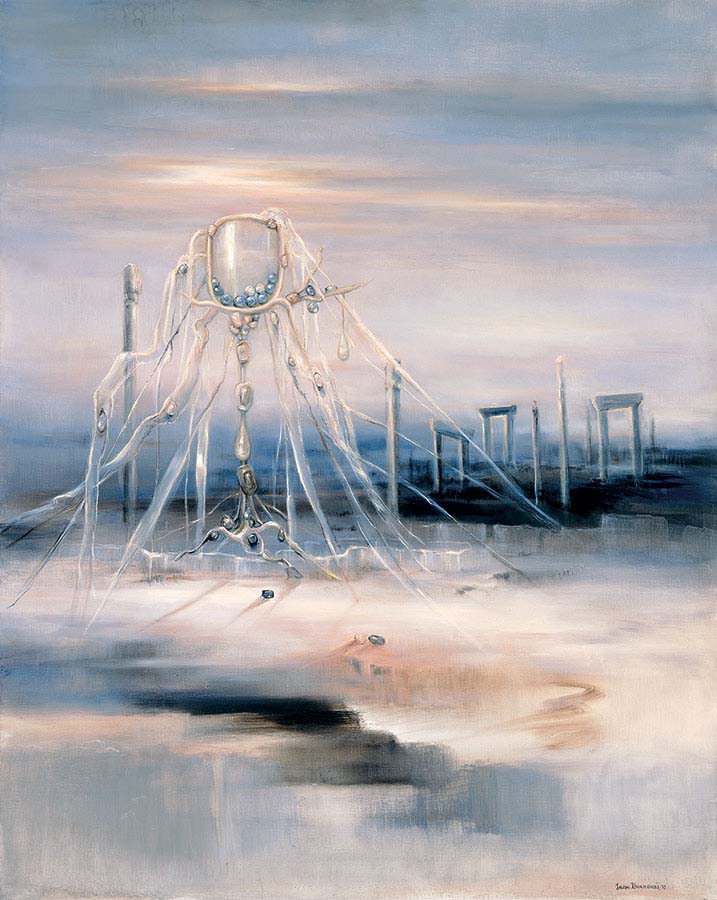
In 1976, Darroudi travelled to Toronto for a solo exhibition of her work at the Heritage Gallery.
This exhibition was part of a massive, whirlwind international tour. Around this exact time, she was showcasing her art at major cultural hubs worldwide, including the Atrium Artis Gallery in Geneva, Galerie 21 in Zurich, Drouant Gallery in Tokyo, and the Museum of Bellas Artes in Mexico City.
The paintings she brought to Toronto showcased her signature style—frequently described as “Ethereal Surrealism.” These pieces blended the delicate, romantic spirit of traditional Persian painting with cold, expansive surrealist landscapes. They featured her iconic elements: vast, desert-like horizons, floating ice or crystalline structures, and a profound, mystical use of light.
I often find myself thinking: if one day I were fortunate enough to own a piece of Darroudi’s work, I would hang it somewhere beyond my room, on a vast wall. A place where, when all the lights are turned off and the city falls silent, the moonlight could fall upon it—bringing it to life—while I drift to sleep, gazing at it.
Perhaps then, I too would enter that world of exploding light, glass, ice, and pearl.